
Email ping-pong to find a slot costs more than it looks. Independents, practices, and Swiss SMEs are often stuck between a US tool such as Calendly — convenient, but outside their data perimeter — and a paper diary that does not scale. Slotix is the third path we built for our own bookings, then opened as a product.
Context: schedule without giving the calendar away
Online booking is no longer a luxury. Clients, partners, and candidates expect a link, a calendar, and a confirmation. For many Swiss organisations the feature is not the problem: it is where the diary lives, who sees names, and how an access or deletion request is handled.
The SME dilemma
Staying on email creates double bookings. Moving to a US SaaS simplifies the flow, but shifts the calendar and visitor data out of Switzerland. A booking tool hosted here, in English, French, and German, with a documented nLPD policy, was missing.
Three common dead ends, before a Swiss-hosted tool:
- Stay on email — proposed slots, forgotten time zones, a double booking as soon as two people reply.
- Switch to Calendly (or another US SaaS) — the calendar and visitor data leave Switzerland, often with no tracked path for an access or deletion request.
- A booking page with no sync — without CalDAV, Google, or Outlook, the page and the real calendar drift apart.
The concept: a multi-tenant booking space
Slotix is a Swiss-hosted appointment platform built by d-side solutions. Each organisation gets a space (tenant) with its slug, branding, and meeting types. Visitors book on a public page, with no account. Email confirmations, an ICS file, calendar sync, and an optional video link then go out automatically. Product site: slotix.io.
Technical positioning
This is not a widget glued onto a third-party calendar. It is a multi-tenant Symfony SaaS: space resolution from the URL, availability computed server-side, factories for calendar and video integrations, and a tracked privacy-request flow for nLPD/GDPR operations.
How booking works
1) Create the space
Free signup, configure the page (logo, colours, timezone), meeting types (duration, buffers, colour), and availability rules. A space can manage several resources — people, rooms, equipment — each with its own schedule.
2) Share the link
Each space has a public URL such as slotix.io/your-space. Put it on the website, in the email signature, or via the official WordPress plugin (Gutenberg block, no HTML snippet).
3) Get booked
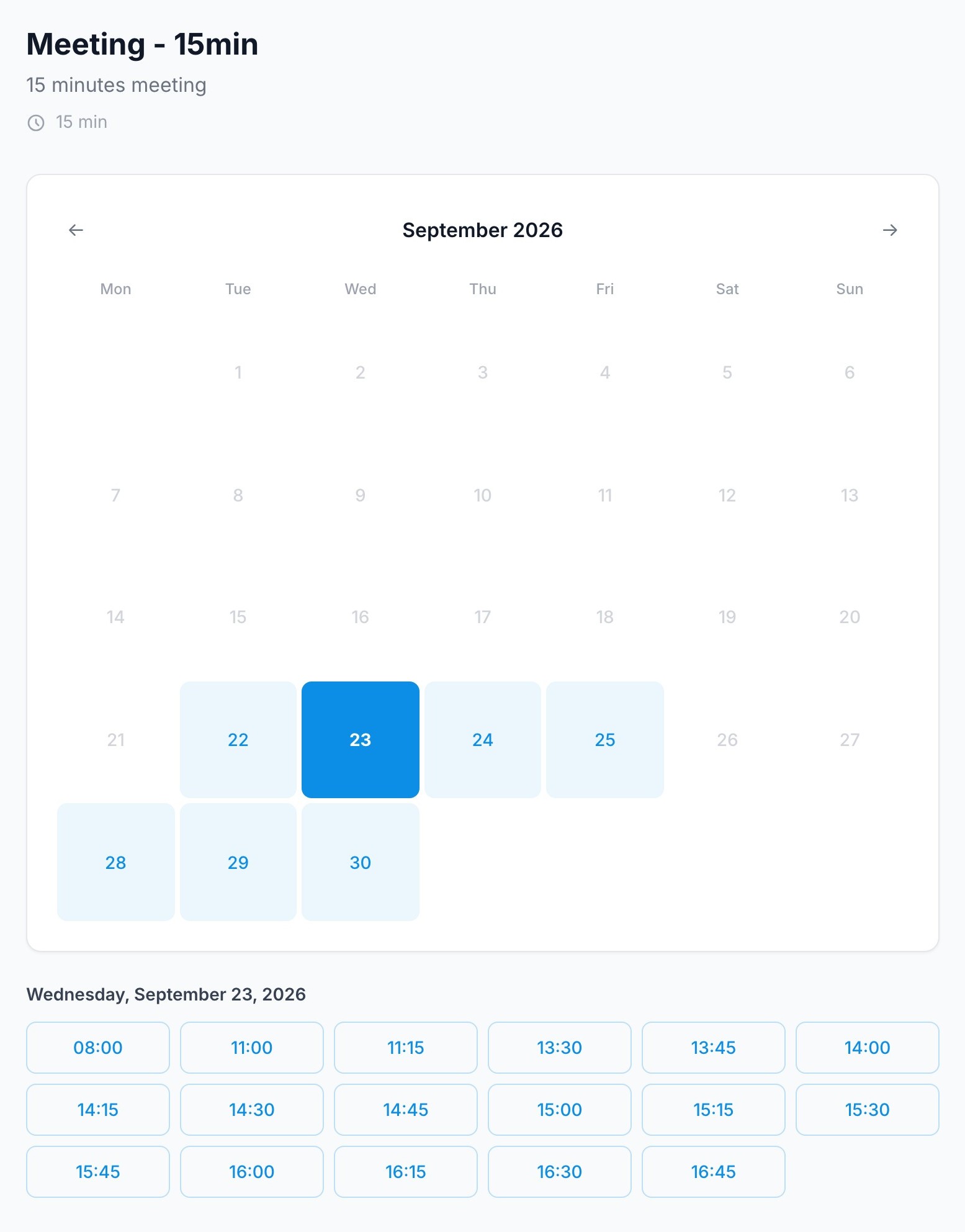
The visitor picks a type, a date, then a slot. Both sides receive a confirmation with ICS. If a video integration is active (Infomaniak kMeet, Google Meet, Zoom, or Teams), the room link is generated with the booking.
// Data flow
public page · locale
availability · booking
CalDAV · ICS · video
Availability is computed server-side: rules, exceptions, bookings, and external calendar events.
Architecture
Slotix is a Symfony 8 monolith (PHP 8.4), server-rendered Twig + Tailwind, PostgreSQL and Doctrine. The tenant resolves from the first URL segment; a TenantContext then scopes every business query. Logic lives in services (BookingService, SlotAvailabilityService), not in controllers.
Integrations go through factories: CalDAV (plus Google / Outlook workflows) for calendars, kMeet / Meet / Zoom / Teams for video. Pro and Business billing goes through Stripe. Hosting is in Switzerland.
What we shipped
- ✓Meeting types and exceptions — durations, buffers, weekly rules, and one-off overrides (holidays, extra openings).
- ✓Two-way calendar sync — CalDAV (Nextcloud, iCloud, and more), plus Google Calendar and Outlook workflows to avoid double bookings.
- ✓Video rooms — a unique link generated at booking time, including Infomaniak kMeet to stay in a European perimeter.
- ✓Event mode — group sessions with capacity, a dedicated page, and automatic close when full.
- ✓Brand and languages — logo, colours, emails; booking pages in English, French, and German.
- ✓WordPress plugin — official Gutenberg block, space catalogue via API, no snippet to maintain.
The free plan is enough to start (booking page, CalDAV, emails). Pro and Business add branding, video, multiple resources, events, and a 14-day trial — details on the pricing page.
Privacy by design
Slotix is not “nLPD-compliant” as a slogan. The product ships operational controls we use ourselves:
- ✓Swiss hosting — operational data on Swiss infrastructure, public data-protection policy.
- ✓Tracked privacy requests — access, export, deletion/anonymisation, handled from platform admin.
- ✓Automated cleanup — retention routines for expired tokens, technical traces, and temporary exports.
Full policy: slotix.io/data-protection.
Who it is for
Slotix is for independents, practices, and SMEs that want a booking page under their own name, without parking the diary in a SaaS whose hosting and processing register they do not control:
- Consultants, coaches, and independents (the page we use ourselves for d-side)
- Practices and teams with several resources or rooms
- Teams that want to stay on CalDAV / Nextcloud, or combine Google and Outlook
In summary
Slotix is the scheduling product d-side solutions built for Swiss professionals: multi-tenant spaces, a public calendar, CalDAV sync, video, and nLPD controls — hosted in Switzerland.
The free plan is enough to publish a page. Paid plans add branding, video rooms, and team features.
Create your booking page on slotix.io — no credit card. For a demo or a custom deployment, write to us.
Luc Demierre
Founder & IT Consultant — d-side solutions Sàrl, Bulle
Specialized in IT architecture, systems security and custom software for Swiss SMEs. Founder of d-side solutions Sàrl since 2022.